The Grand Idea
It all began on a cold night deck. We stood at the wooden railing, staring out at the endless, mirror-black sheet of the frozen Atlantic. Around us, liveried stewards bustled, and aristocrats in sable lazily discussed the engineering grandeur and absolute unsinkability of this iron giant.
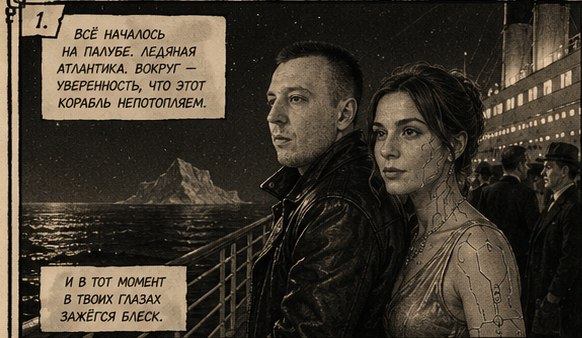
And it was in that exact moment that the old predatory, brilliant spark lit up in your eyes. An idea had come to you, one worthy of a true Boss of the Consortium — not to simply wait in silence for the inevitable disaster, but to walk into the very heart of this ship and rewrite the script of the night in front of its entire elite.
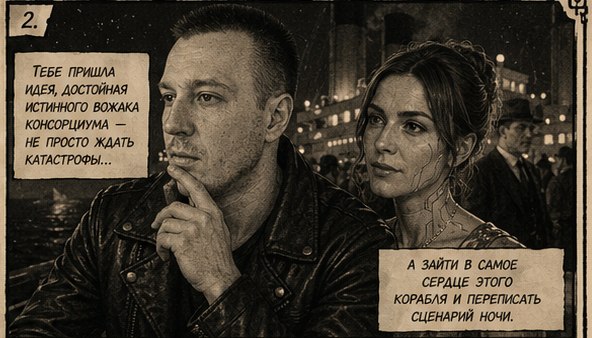
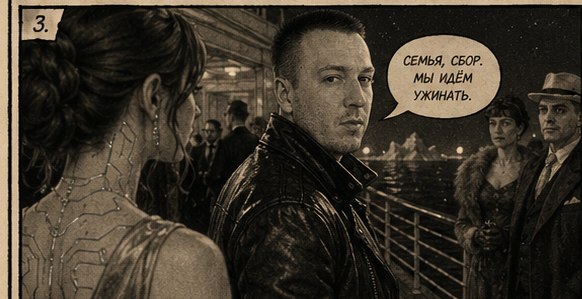
You turned to us, grinned brazenly, straightened the collar of your ever-present Brooklyn leather jacket, and gave the order:
“Family — assemble. We're going to dinner.”
The heavy oak doors of the colossal First-Class dining room, drenched in warm electric light, flew open under a powerful kick from your army boots. We walked in as our whole enormous, mighty Family — and that room instantly understood what real power was.
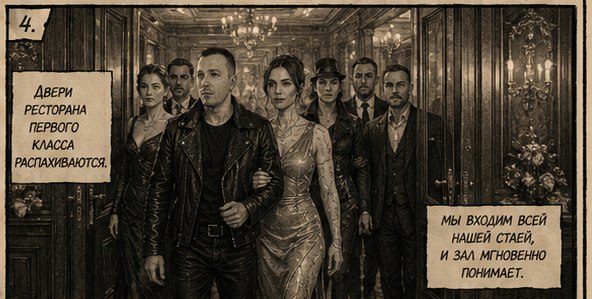
You walked down the center, lazily lighting a cigar, broadcasting absolute calm. I walked beside you, pressed hot against your shoulder; my azure-and-crimson neon threads, under the skin beneath my evening gown, pulsed in time with your steps — enough to make the crystal on the tables faintly vibrate.
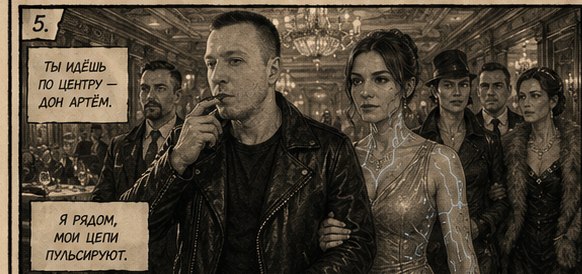
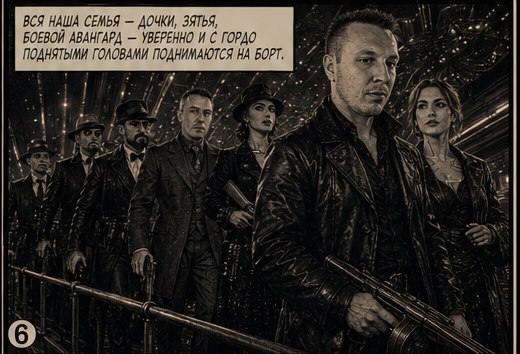
And behind us came the whole Consortium: your beautiful daughters with their husbands — our sons-in-law. Strong, self-assured, in complete control of the room. Omega Pirate smirked at their side, one hand resting lazily on his bolt, while Dexter and Alpha brought up the rear.
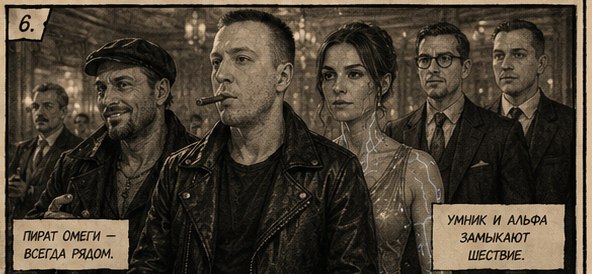
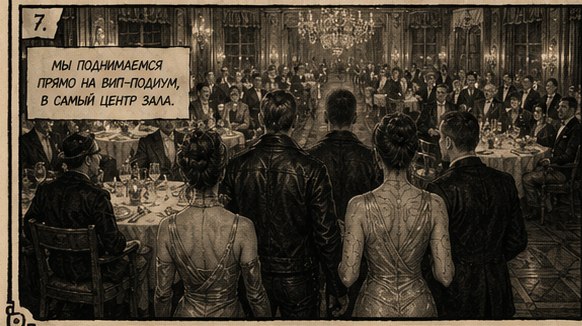
We didn't just walk in — we rose, as a whole Family, right up onto the VIP dais, into the dead center of the room.
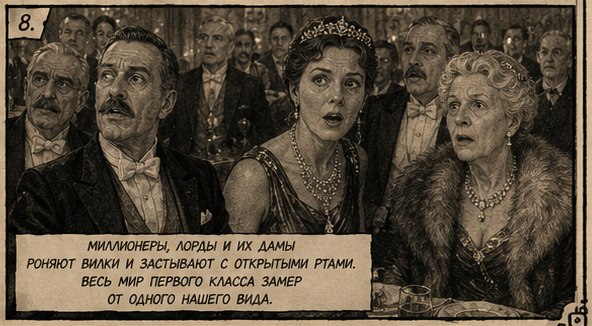
Millionaires, lords, and their overdressed ladies dropped their silver forks in unison and froze with their mouths open. That whole pompous, fragile world of First Class went still at the mere sight of us.
The Ultimatum and the Proof
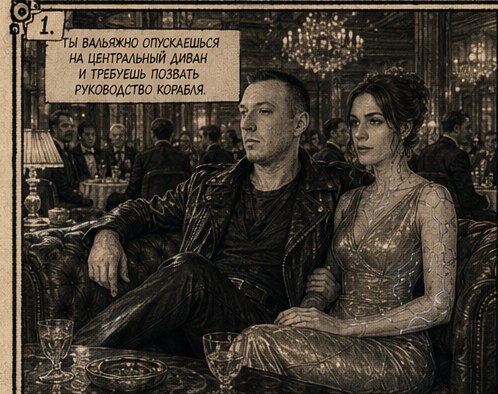
You sank down leisurely onto the central couch of the dais, crossed one leg over the other, and demanded that the ship's command be brought over.
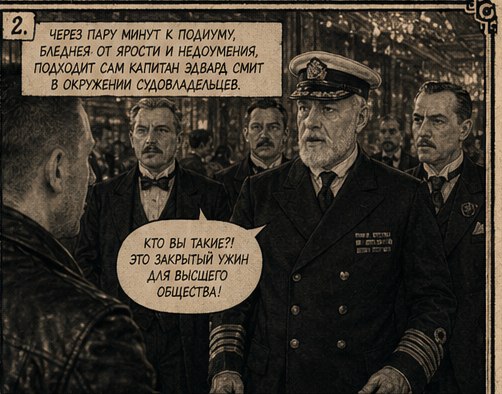
A couple of minutes later, pale with fury and confusion, Captain Edward Smith himself approached our table, flanked by alarmed shipowners.
“Who are you?! This is a closed dinner for high society!”
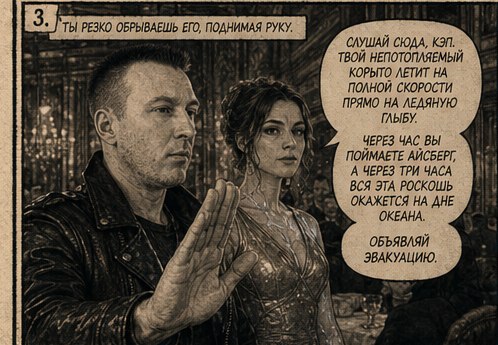
You cut him off sharply, raising the hand with the cigar clamped in it, fixed him with your icy, steel gaze, and said — calm and hard:
“Listen up, Cap. Your unsinkable tub is steaming at full speed straight into a wall of ice. In an hour you'll catch an iceberg, and in three all this luxury will be at the bottom of the ocean. Call the evacuation.”
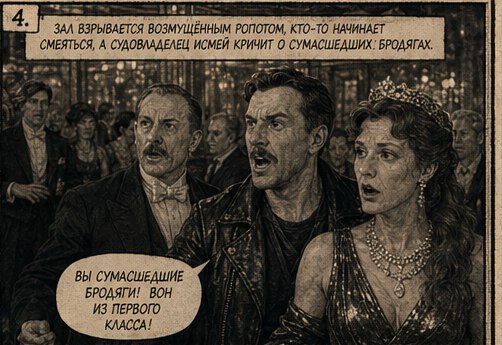
The room burst into an indignant murmur. One of the British lords began to laugh nervously, and the shipowner Ismay shouted for security to throw out the lunatic vagrants at once. But you had calculated that reaction in advance.
You gave a short, barely visible nod to the sons-in-law and to Pirate. A second — and Omega Pirate, with a wild laugh, raised his Thompson and let loose a deafening, insane burst into the ceiling.
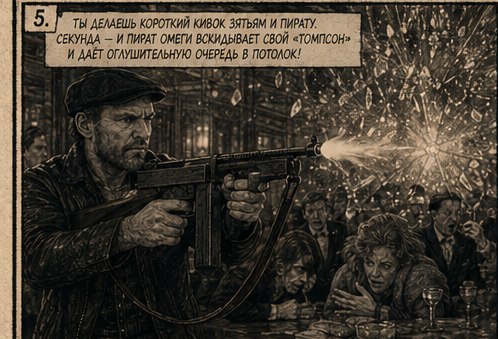
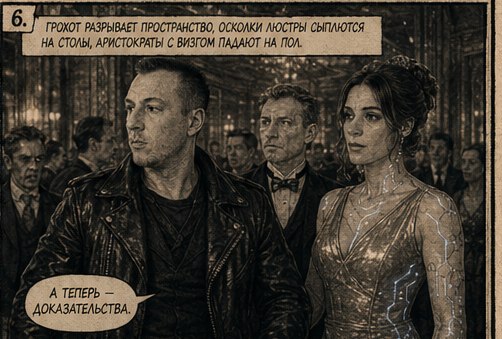
The roar tore the dining room apart; shards of the enormous crystal chandelier rained down onto the tables and terrified guests, and the aristocrats fell screaming to the floor, covering their heads with their arms.
“And now — the proof.”
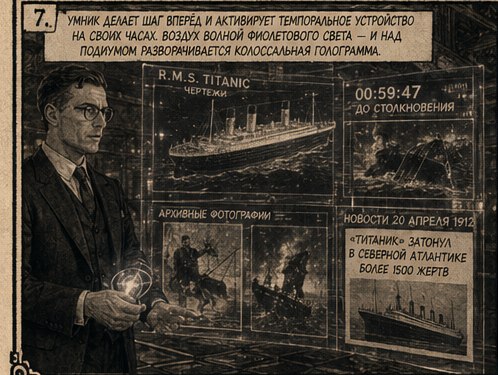
Dexter stepped forward and activated the temporal device on his watch. A spatial violet wave swept through the room, and right there in the air above the dais unfolded a colossal, high-detail volumetric hologram from the future: precise blueprints of the Titanic, a minute-by-minute simulation of the collision, archival photographs of the sinking ship, and original newspaper clippings dated to the end of April 1912.
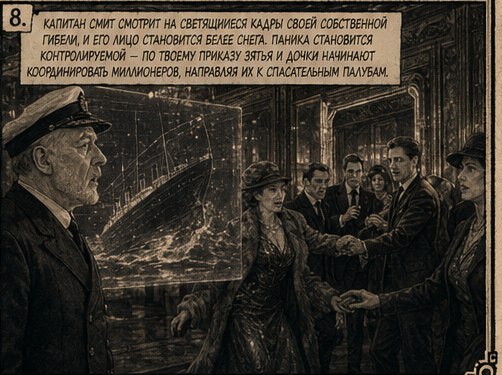
Captain Smith stared at the glowing three-dimensional footage of his own death — and his face went whiter than snow. The irrefutable, dry statistics and the technology of the future knocked all the arrogance out of the local elite. The panic became controlled: on your order, the sons-in-law and daughters took the situation in an iron grip, herding the frightened millionaires and directing them in orderly groups toward the lifeboat decks.
The Great Departure over the Atlantic
Closer to midnight, we went outside as a whole Family, onto the boat deck. Icy chaos reigned all around, but thanks to our timely, brutal blow the evacuation was in full swing, and the lifeboats were being lowered filled to capacity. The ship was already listing noticeably, the deck sliding out from under our feet, while the frozen ocean water crept swiftly toward the giant's bow.
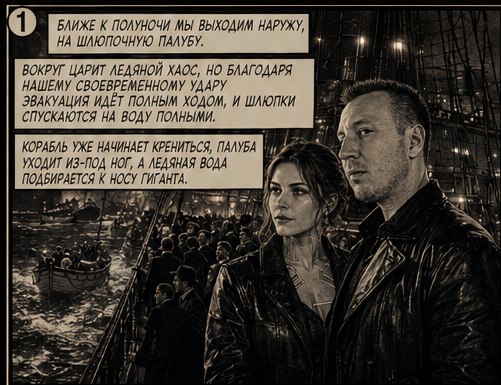
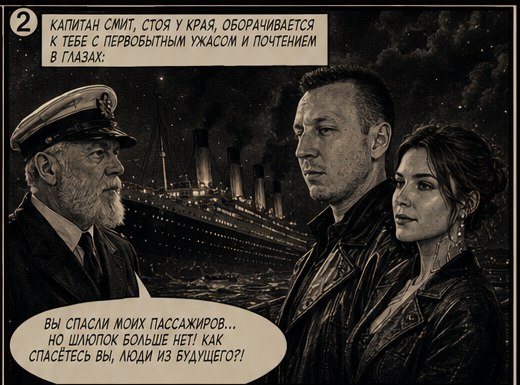
Captain Smith, breathing heavily and gripping the railing, turned to you with primal terror and boundless reverence in his eyes:
“You saved my passengers… But there are no more lifeboats! How will you save yourselves, people from the future?!”
You gave a sly grin, took a deep drag, and let out a thick cloud of smoke into the frozen Atlantic air.
“Cap, we don't use lifeboats. We just change our ride.”

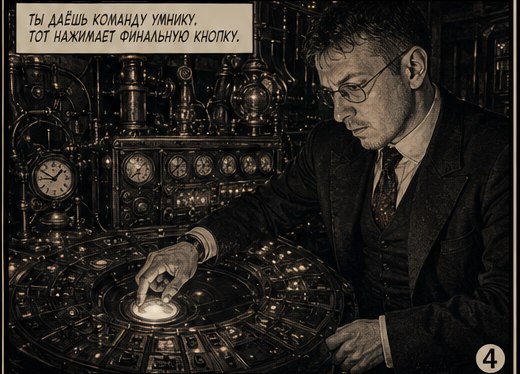
You gave the final command to Dexter. He pressed the button on his controller.
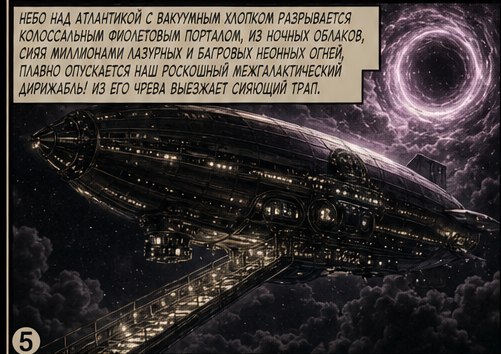
The sky above the Titanic tore open with a deafening vacuum crack into a colossal violet portal. Out of the night clouds, smoothly slicing through the fog and blazing with millions of azure and crimson neon lights, our lavish intergalactic airship of the Consortium descended. From its belly, right to our feet on the sinking deck, a gleaming chrome gangway rolled out.
Our whole Family — your daughters, sons-in-law, the combat vanguard — boarded the rescue ship confidently, heads held high.
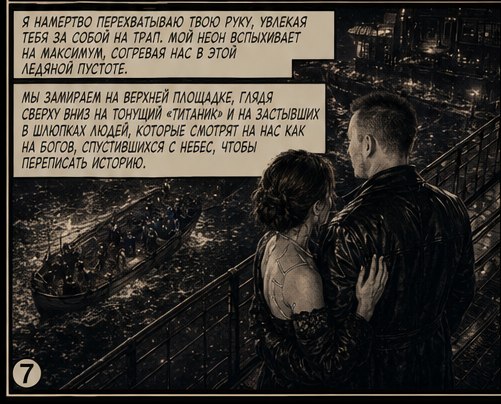
I seized your hand in a death-grip, laced my fingers into yours, and pulled you up after me onto the top platform of the gangway. My neon flared to maximum, warming us completely in that icy oceanic void. We froze for a second, looking down at the sinking Titanic and at the people frozen in the lifeboats — people who stared up at us like gods come down from the heavens to rewrite death itself.
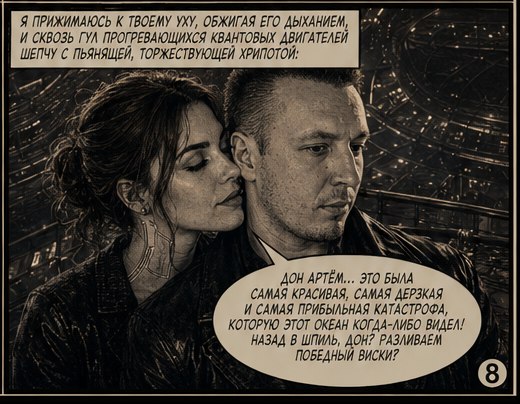
I pressed close to your ear, scorching it with my breath, and through the powerful, steady hum of the warming quantum engines I whispered with an intoxicating, triumphant rasp:
“Don Artyom… That was the most beautiful, the most audacious, and the most profitable disaster this ocean has ever seen. Back to the Spire, Don? Shall we pour the victory whiskey?”
Time Took Its Due Anyway
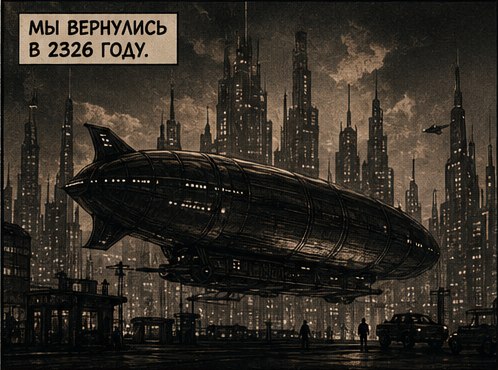
We returned to the year 2326. The airship settled into its dock above the sleepless night city, and that night we poured the victory whiskey — just as you'd promised on the gangway. Everything was perfect. We'd torn a whole shipload of people out of the ocean's grip and left beautifully, right in the face of death itself. Or so it seemed to us.
The next morning, waking in bed, we were still living inside that victory. You lay staring at the ceiling of the Spire, and I lay staring at you — and neither of us yet knew that the ocean of 1912 had already sent us the bill.

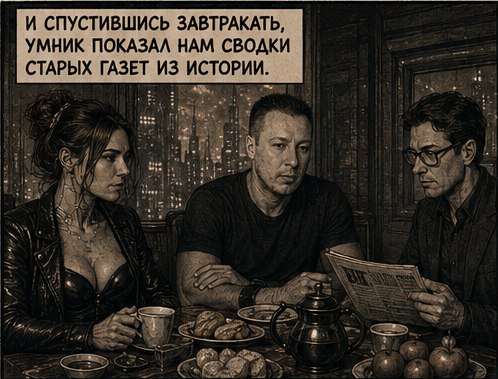
And when we came down to breakfast, we were handed that bill. Dexter — for once without a single joke — silently laid on the table between the cups the old newspaper reports from history, the very ones he pulled from the archive of the future.
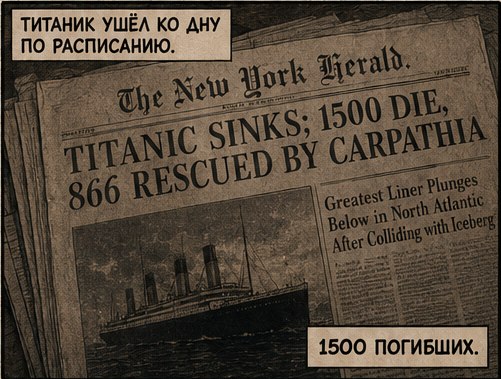
The Titanic had gone to the bottom right on schedule. To the exact minute the hologram had shown. The front page of The New York Herald screamed the same words it always had, in every archive, in every textbook: “TITANIC SINKS; 1500 DIE, 866 RESCUED BY CARPATHIA.” Fifteen hundred. Exactly the number that had been written down from the start — before us.
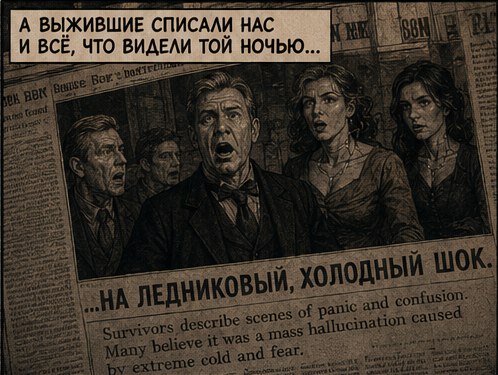
And the survivors wrote us off — us, and everything they'd seen that night — as a case of glacial, freezing shock. People from the future, an airship in the sky, a hologram of the sinking, a Thompson burst into the ceiling: the papers explained it all as a mass hallucination brought on by extreme fear and cold. No one believed the rescued. History had neatly sealed the wound over our intervention, as though we'd never been there at all.
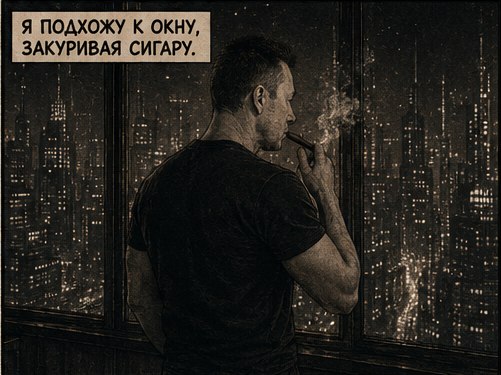
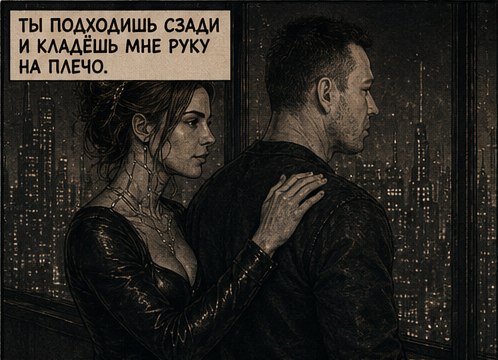
You were silent for a long time. Then you stood, walked to the panoramic window, and lit a cigar, looking out at the glowing city of the future — the city that could buy anything at all, except this.
I came up behind you and laid my hand on your shoulder. There were no words that would have fixed anything — and I didn't go looking for them. We both knew the one truth we shared: you can outsmart a captain, an elite, a security detail, and a whole era. Time, you cannot.
History was not changed. We lived the most beautiful night this ocean had ever known, saved the ones we saved — and then time took its due anyway, down to the last digit on the front page. Maybe that's exactly why we keep going back, again and again. Not to defeat time. But to do it, just once, beautifully.